
 100% Confidential

1. What are IOP programs?
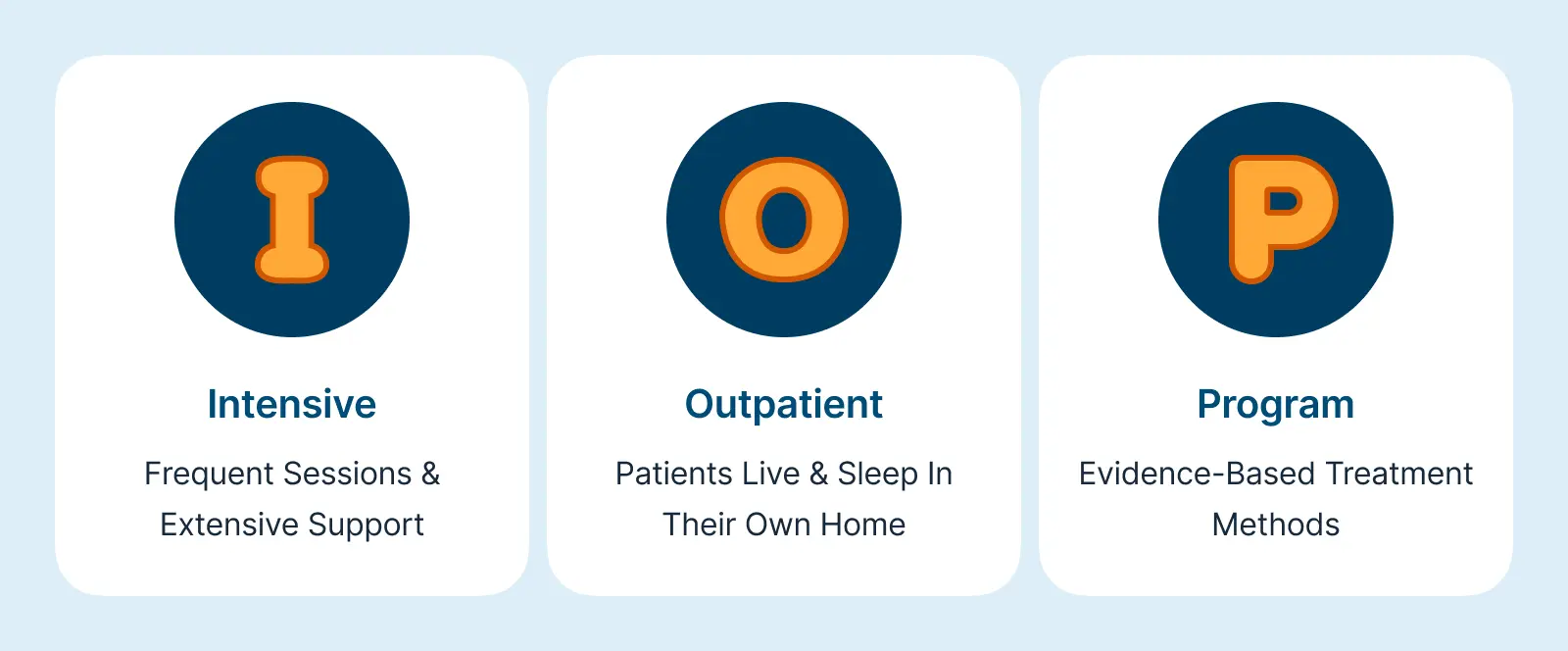
An Intensive Outpatient Program (IOP) is a proven treatment option for the disease of drug or alcohol addiction.
IOP involves attending 3-hour group therapy sessions 3 times per week, with one-on-one therapy sessions weekly as well.
IOP allows patients to live at home and manage work, family, or school commitments. IOP sessions are often held in the morning when kids are at school or in the evenings after working hours.
IOP provides support for managing real-life triggers in the “real world” while receiving treatment.
2. How does an IOP program work?
IOP starts with an in-depth assessment and involves ongoing group therapies, individual therapies, and support services.
1. Assessment
Every IOP starts with a thorough assessment. A trained professional evaluates your specific situation, including:- Your substance use history
- Any mental health concerns
- Your overall health
- Your support system and living situation
This helps create a personalized treatment plan that fits your needs.
2. Group Therapy
Group therapy is the core of IOP. You meet regularly with people who understand your struggle to:- Share experiences and learn from each other
- Build a support network
- Gain different, credible perspectives on addiction and recovery
These sessions help you feel less alone and learn valuable, practical strategies for staying sober.
3. Individual Therapy
You’ll also have one-on-one sessions with a therapist, usually focused on Cognitive Behavioral Therapy (CBT), motivational interviewing, and Dialectical Behavior Therapy (DBT) techniques. These personal therapy sessions allow you to:- Work through sensitive issues in depth
- Address any underlying mental health concerns
- Develop personalized coping strategies
- Set and track individual recovery goals
One-on-one therapy provides focused attention on your specific challenges and progress.
4. Support Services
IOPs should include additional support services such as:- Life skills training (including stress management & communication skills)
- Family therapy
- Recovery Coaching
- Referrals to community resources (including support meetings or housing assistance)
- Medication options (available if needed here, though not common for all IOPs)
These services address the many aspects of your life affected by addiction and support your overall well-being to stay well long-term.
NOTE: For patients who experience serious withdrawal symptoms, detox is usually recommended before IOP for 3-10 days. This is especially critical for patients struggling with alcohol, opioids, or benzodiazepines. Patients with jobs often use PTO during this period, and then continue working while attending IOP without needing any extended leave.
3. How long are IOP programs?
Intensive Outpatient Programs (IOPs) typically last 8 to 12 weeks. It depends on individual progress and the severity of the issue. Patients participate in therapy for 3-4 days per week, with group sessions lasting 3 hours and one-on-one sessions lasting 1 hour.- Therapy sessions 3-4 times per week
- 9-10 hours of therapy total per week
- Lasting 8-12 weeks
Get as much care as you need to stay on track until you don’t need the extra support anymore.
4. What does an IOP program look like?
IOP looks like a therapist’s office. Group rooms have about 12 chairs in a circle. One-on-one therapy is done with just you and the therapist in the room. It’s not scary.
Some IOP programs also offer medication management to support addiction recovery. Depending on the program and individual treatment needs, medications such as naltrexone may be considered alongside therapy and other recovery services.
5. Is IOP the same as AA?
No, IOP here is not 12-step-based. IOP group sessions are led by a master’s-level clinical therapist. You work through core issues like motivation, preventing negative thought patterns, relapse prevention, and establishing or rebuilding healthy relationships. You also work through underlying issues like depression or anxiety. Group sessions are small and personal.
You also meet with the therapist individually for more sensitive and personal therapy and to ensure you are making progress. Your therapist connects you to any further resources, including meeting with the medical team for medication options.
IOP goes well beyond any 12-step support meetings, though meetings like AA, NA, and SMART Recovery can be helpful in addition to and after IOP.
6. Do IOP programs drug test?
Yes, IOP programs drug test. However, the purpose isn’t to judge or punish you. Drug testing is done to ensure your safety and monitor how treatment is working. It helps clinicians adjust your treatment plan if needed, based on your progress. Insurance companies typically require drug testing as part of their criteria for covering IOP treatment too.
7. How much do IOP programs cost?
Most IOP patients here use health insurance. IOP is covered by all major health insurance companies, including BCBS, Aetna, Cigna, Humana, and United Health Care.
Your cost with insurance depends on your specific plan’s deductible and co-insurance amounts. Patients with medical care earlier in the year, such as hospitalizations or rehab, often owe $0.
We can check your specific policy and let you know any costs before you come in.
Patients are also welcome to self-pay. We offer various payment plan options. The cost of IOP here is 2-12x less than inpatient rehab.
8. Do I have to do the group therapy?
Most people aren’t excited by the idea of being in a group for therapy. Try it anyway. Even the most introverted patients agree that IOP works and even enjoy it. Plus, IOP groups should stay small (a maximum of 8-12 people), which is monitored by licensing and accreditation boards. ⓘ
Group therapy offers:- Peer Support: Addiction is isolating. We often feel like no one understands what we're going through. Engaging with those with similar challenges is a powerful reminder that you're not alone.
- Shared Learning: Peers often share unconventional tips that don't come from formal therapy methods. It's also easier to see the flaws in other people's thinking, which helps you realize you may have similar unproductive patterns.
- Accountability: Supporting each other can motivate you to stay on track. Patients often stay in touch long after IOP ends to keep each other accountable, knowing how hard it can be.
- Social Skill Development: Many people living with addiction have unhealthy relationships and communication skills. Learning to create healthy friendships helps you stay healthy too. Recovery is NOT boring!
9. Do IOP programs work?
Research into IOP effectiveness consistently demonstrates the following facts.- IOP helps people use less drugs and/or alcohol. Many stop drinking alcohol and using drugs completely.
- The results last. Most people who complete IOP are still sober a year and a half later.
- IOPs work just as well as inpatient rehab. At least 17 research studies show IOP is as effective as inpatient rehab in keeping patients well long-term. ⓘ
- Experts agree IOP is effective. All major health organizations support the use of IOP, including the Substance Abuse and Mental Health Services Administration (SAMHSA).
-Department of Public Health & Preventive Medicine
10. IOP vs Rehab - which is better?
IOP and inpatient rehabs provide the same therapeutic foundation for overcoming addiction issues and related mental health issues like anxiety and depression.
IOP is a great option if:- You’re just noticing an addiction issue
- You’re coming from inpatient rehab, inpatient detox, or a hospital
- You have relapsed after months/years of sobriety
- You’ve been in and out of treatment programs for years
Inpatient rehab is likely a better option if you’re struggling with more severe co-occurring issues (like psychosis or active suicidal thoughts).
11. What's the difference between IOP, PHP and OP?
The main differences lie in the intensity and access.
PHP (Partial Hospitalization Program)
- 20+ hours of treatment per week.
- Patients attend all day but return home at night.
- IOP is appropriate for many patients with inpatient rehab recommended for those with severe needs. As a result, true PHP options for substance use are relatively limited. Many inpatient rehab programs bill insurance for PHP to extend patients' stays. However, for patients, this often involves still residing on the inpatient campus, away from home and family and not a true outpatient experience.
IOP (Intensive Outpatient Program)
- Typically 9-10 hours of treatment per week
- Patients live at home and continue working
OP (Outpatient Program)
- Least intensive, usually 1-4 hours of treatment per week
- Typically involves weekly individual or group therapy sessions.
- OP is typically recommended after IOP or PHP. It is generally not considered as effective as a first-line treatment option for most patients with substance use disorders.
12. Will anyone know I'm enrolled in the IOP program?
No, IOP programs are meant to work around work, family, and school obligations without having to take any noticeable leave.
Your privacy is protected by HIPAA and applicable federal and state medical privacy laws. We cannot confirm or deny whether a specific person is receiving treatment without appropriate authorization, nor can we disclose their medications or treatment progress.
That said, there’s no shame in having the disease of addiction, and it’s a great thing that you’re seeking treatment! Support and accountability can come from being honest with trusted loved ones. Addiction thrives in isolation and secrecy.
13. How can I convince someone to start IOP?
Your loved one is lucky to have your support, and you probably have more leverage than you think. Try gathering 3-5 other people who support the idea of treatment and approach your loved one together with care and concern (not anger or frustration).
You should call the IOP ahead of time so your loved one is scheduled for the same day or the next day as the conversation. Unlike inpatient rehabs, a clinic is not a big ask. The goal is to get them to show up to the initial appointment.
14. How do I find an IOP program near me?
If you're looking for an IOP program near you, explore treatment options at The Recovery Team or give us a call to discuss your specific needs and available programs.
You can also visit FindTreatment.gov to search for IOP programs in your area, including providers that may accept Medicaid or Medicare.
15. How do I start the IOP Program?
For most IOPs, the first step is a simple phone call to see if the IOP program is a good fit and to get scheduled. The call can be as short as 2 minutes, or you can talk as long as you need to get all your questions answered.
The first appointment that is scheduled is an assessment with your therapist. Your therapist gets to know you and starts creating a treatment plan to best help your specific situation. The assessment also ensures insurance covers your IOP program.

